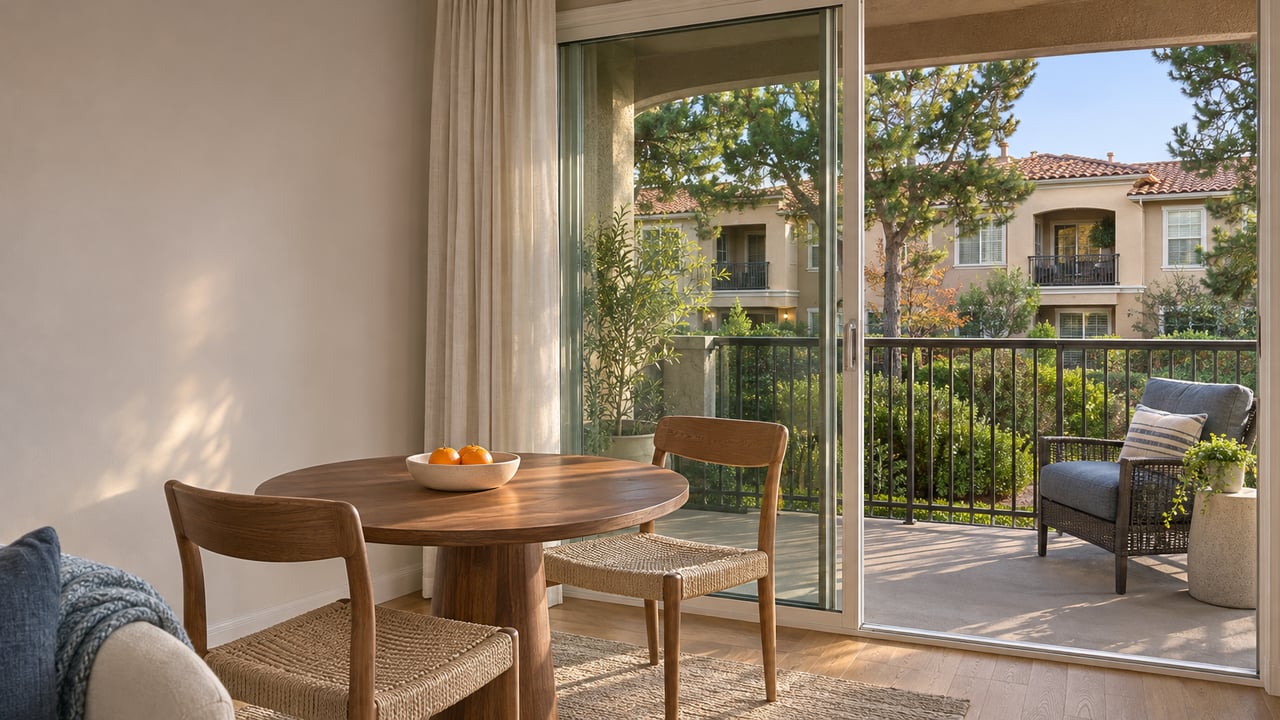
Picture an Oceanside listing marketed as a turnkey vacation rental. It comes furnished, with a booking calendar, a run of guest reviews and a seller's spreadsheet showing nightly revenue. A buyer builds a pro forma from that spreadsheet, prices the offer to match and opens escrow. The city's position is that none of that income comes with the deed. Oceanside short-term rental permits are non-transferable, and when ownership changes, the city says a new account must be established.
Value a vacation rental here the way the city treats it. The asset is the permit you, as the next owner, can get on that specific parcel. The permit the seller holds today tells you almost nothing about that. Where the parcel sits on the zoning map decides whether a new permit is available, whether it is capped, or whether it is gone for good.
The Seller's Permit Ends at Closing
Oceanside defines a short-term rental as a dwelling, or part of one, rented for no more than 30 consecutive days. The rules split hosted units, where the owner lives in the home and stays on site while renting part of it, from non-hosted units, which is what most investors mean by a whole-home vacation rental.
For non-hosted rentals outside the Coastal Zone, the city's STR FAQ, updated June 30, 2026, says this:
Non-hosted short-term rentals located in any residential zoning district outside of the Coastal Zone are prohibited. A short-term rental permit issued for a property outside the Coastal Zone prior to February 10, 2024 shall not be renewed after the property is transferred to a new owner.
A home east of the Coastal Zone can still be running legally under a permit issued before February 10, 2024. The city's permit program updates page says those permits can be renewed while in good standing but "will not be renewable after the property is sold." For a buyer, the booking history on that house is a record of the seller's business. It is not a forecast of yours.
Where a New Owner Can Still Get One
Since the seller's permit can't carry over, the question becomes whether a new permit is possible on that parcel. The city's short-term rentals page gives a buyer a sequence of filters, and a property has to clear every one:
- Coastal Zone or not. New non-hosted rentals have been prohibited outside the Coastal Zone since February 10, 2024. The city sends owners to its GIS map viewer to confirm a parcel's status.
- ADU history. If an ADU or JADU on the property was permitted on or after September 9, 2017, neither that unit nor the main house can be used as a short-term rental under Oceanside Zoning Ordinance 3006(E)(3). An investor counting on a backyard unit to boost a vacation rental's numbers can end up disqualifying the whole property.
- Ownership, not tenancy. Tenants can't offer a property as a short-term rental.
- Lot and site type. Short-term rentals are prohibited in mobile home parks and on non-conforming panhandle, or flag, lots.
- The HOA. The city doesn't enforce private CC&Rs and tells owners to check with their homeowners association for any added restrictions.
Hosted rentals are allowed in all zoning districts. That helps an owner-occupant renting a room. It does nothing for an investor who doesn't plan to live in the home.
West of Coast Highway, a Cap Is Pending
Inside the Coastal Zone, short-term rentals are allowed today. That could change. On May 8, 2024, the City Council adopted an ordinance amendment that would cap non-hosted permits at 480 in residential zones west of Coast Highway, prohibit new non-hosted rentals in the R-1 zone, and require permits for every short-term rental, including hosted units in the Coastal Zone.
The size of the cap matters. The city's April 24, 2024 staff report said 480 would allow "approximately 25 more" non-hosted rentals west of Coast Highway beyond the number already permitted or in process at the time. In other words, the cap was set to freeze the area close to its spring 2024 count. That roughly 455 figure is a 2024 snapshot, not a current count. Even so, the design leaves very little room for growth.
None of these coastal changes has taken effect. They need the California Coastal Commission to certify a Local Coastal Program Amendment, LCPA24-00001. The city says it submitted the application in late summer 2024, and that city and Commission staff have been supplying more information so the application can be deemed complete and scheduled for a hearing. A city staff report dated October 21, 2026 describes the amendment as "awaiting Coastal Commission review."
That leaves coastal buyers pricing a rule that has been adopted locally and is still on hold, with no hearing date. Under the language the council adopted, an existing permit west of Coast Highway can be renewed unless the owner gets permits to expand habitable square footage or transfers the property to a new owner. Once certification happens, every sale in that area puts the parcel's eligibility back on the line. In R-1, the answer would be no. Elsewhere west of Coast Highway, the new owner would be applying under a cap that was nearly full by design. The table below summarizes the rules in the city's STR FAQ and on its short-term rentals page.
| Property situation | New owner, non-hosted STR today | After LCPA24-00001 is certified |
|---|---|---|
| Residential zone outside the Coastal Zone | Prohibited since Feb. 10, 2024; the seller's permit can't be renewed after sale | No change |
| Coastal Zone, R-1 zone west of Coast Highway | Allowed with a permit | New non-hosted permits prohibited |
| Coastal Zone, other residential zones west of Coast Highway | Allowed with a permit | Allowed only under the 480-permit cap |
| Gated HOA, 50+ units, 24-hour security or on-site management | Exempt from the STR permit; TOT certificate still required | City says all STR properties would need a permit |
| Property with an ADU or JADU permitted on or after Sept. 9, 2017 | Prohibited, including the main house | No change |
Why the Gated Communities Stand Apart
The HOA exemption explains where much of Oceanside's vacation rental inventory sits. In April 2024, the city counted roughly 1,211 registered short-term rentals, about 833 of them in the Coastal Zone. North Coast Village accounted for 331 of those coastal units. North Coast Village and the St. Malo gated community were the permit-exempt communities the staff report named. Under the code section reproduced in that staff report, exempt units skip both the STR permit and the operational requirements, provided they stay in compliance with transient occupancy tax rules. They still have to register for a TOT certificate.
This is also where a buyer's assumptions are most exposed to the pending amendment. The city's short-term rentals page says the proposal awaiting approval "would require all STR properties to obtain an STR Permit." Anyone paying extra for a condo because it rents without a permit is betting that the exemption outlasts certification.
Enforcement Is Getting Automated
Fines are tougher than they used to be. When the 2024 rules passed, The Coast News reported new fines of $1,500 for a first violation of operating without a permit and $2,500 for a second or later one.
Detection is the newer change. On October 21, 2026, the City Council approved a $269,539, three-year agreement with Deckard Technologies, with options for two one-year extensions, for STR monitoring, compliance and registration through Deckard's Rentalscape platform. Staff selected it from five responses to a March 2026 request for proposals, according to the staff report. Citizen Portal reported that the council approved the Deckard agreement and the vendor extension below in unanimous votes. The council also extended the city's current vendor, Neumo Group, which runs the MUNIRevs system behind the 24-hour complaint hotline and the registration portal. According to the amendment's staff report, the extension adds $17,335 and six months, running November 6, 2026 through May 5, 2027, to cover the handover.
Next to the risk, the cost of operating legally is small. According to the city's STR FAQ, the permit is $250 a year, plus a $220 inspection at registration and at least every three years after that. The city's transient occupancy tax page lists a 10% tax on guests plus a 1.5% Tourism Marketing District assessment. Overnight occupancy is capped at two adults per bedroom plus two more people per unit, with up to 10 daytime guests between 7 a.m. and 10 p.m. A pro forma built on a large group-rental model has to fit inside that occupancy limit.
Common Questions
Can I take over the seller's permit if I close quickly?
No. The city says STR permits are non-transferable and that a change in ownership requires a new account. Outside the Coastal Zone, there is no new non-hosted permit to apply for.
Does renting for longer than 30 days fall under these rules?
The city's definition covers stays of no more than 30 consecutive days. Longer stays fall outside that definition, and the rules covering them are a separate question to raise with the city before you buy.
How do I find out which rules apply to a specific address?
Start with the city's GIS map viewer, linked from its short-term rentals page, to check whether the parcel is in the Coastal Zone. The city also says staff review the property's zoning and STR eligibility when you apply for a transient occupancy tax certificate. The city's STR program updates page states plainly that there is no guarantee new permits will be approved or existing ones renewed.
This post is general information, not legal, tax or financial advice. Before you rely on any of these rules for a purchase, confirm your property's status with the City of Oceanside and the right professionals.
If you're underwriting an Oceanside vacation rental, start with the parcel's zoning before you look at the seller's revenue history. Christopher Burgos and our team can help you confirm permit eligibility and Coastal Zone status, then pressure-test the numbers before you write an offer. Schedule a Consultation.