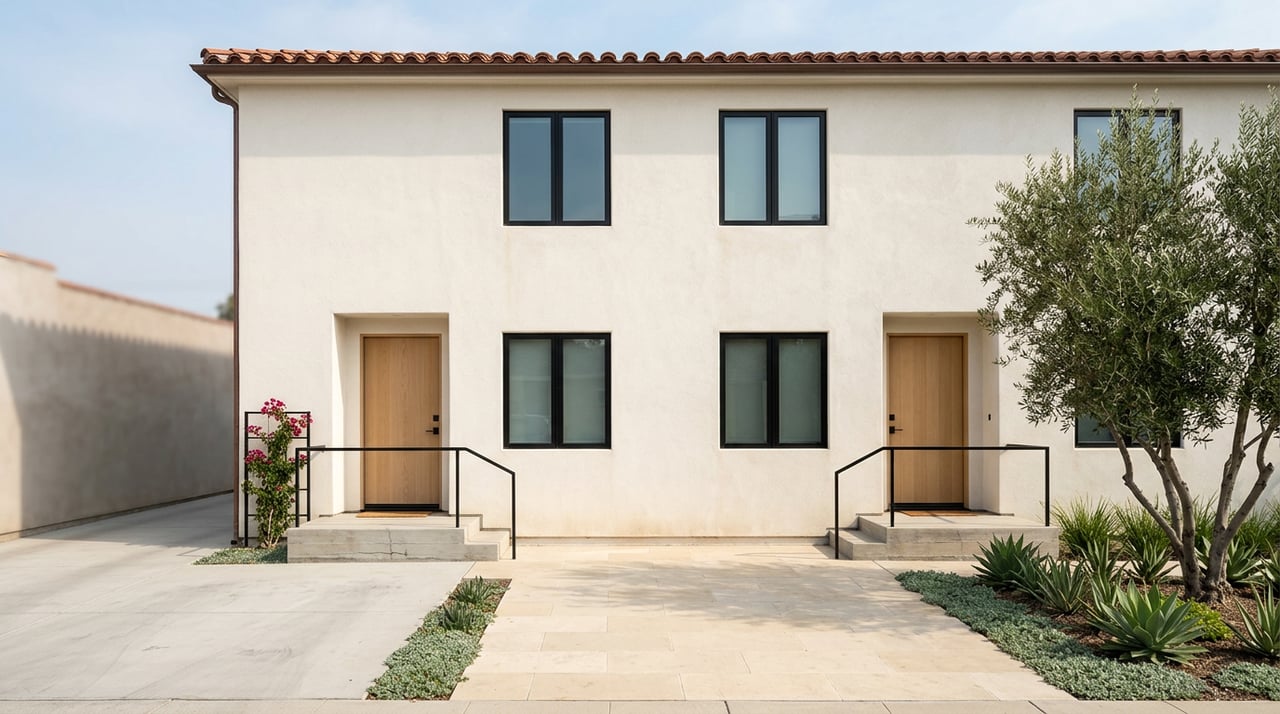
You want to live in Chula Vista without stretching your budget, and you also want to build wealth. House hacking with a duplex can do both. When you live in one unit and rent the other, the rental income can help cover your mortgage and even help you qualify for the loan. In this guide, you will learn the programs that allow low down payments, how lenders count rent, what local rules to know, and a simple example that shows the monthly math. Let’s dive in.
What house hacking means
House hacking means you buy a 2–4 unit property, live in one unit, and rent the others. With a duplex, you get a neighbor and a rent check. The key benefits are a lower out-of-pocket housing cost, a head start on real estate equity, and loan programs that let you use projected rent to qualify.
Market snapshot: Chula Vista
Chula Vista is part of the high-cost San Diego market. Public indexes show typical home values in roughly the $750,000 to $850,000 range as of early 2026 (Zillow ZHVI, Feb 2026). Citywide average asking rents run about $2,600 to $2,900 depending on bedroom count and neighborhood (RentCafe, Feb 2026). You should always check current comps for the specific zip code and unit size you plan to rent.
Multi-unit conforming loan limits are higher than one-unit limits in San Diego County. That matters because it can keep a duplex purchase within conforming rules instead of going jumbo. For exact 2026 limits, review the FHFA county list for San Diego County in the official FHFA 2026 conforming loan limits.
Loans that allow owner‑occupied duplexes
Several well-known programs allow you to buy a 1–4 unit property when you live in one unit. Each counts rental income a little differently and sets its own down-payment rules.
FHA
- What it is: A federal program that insures loans for 1–4 unit properties when you occupy one unit. See the HUD FHA loan overview.
- Minimum down payment: Often 3.5% for qualifying credit.
- Counting rent: Lenders follow HUD’s Single Family Housing Policy Handbook 4000.1 for documentation and calculations. For a duplex, projected market rent from the appraiser or a signed lease can be used to help you qualify. Review the HUD Handbook 4000.1 for details.
Conventional (Fannie Mae/Freddie Mac)
- Key update: Fannie Mae allows up to 95% LTV on owner‑occupied 2–4 unit purchases under standard DU rules, effective Nov 18, 2023. See the policy change summary from Fannie in this Desktop Underwriter update.
- Why it helps: With as little as 5% down on a duplex, conventional can compete with FHA. Conventional PMI can be removed once you reach 20% equity, which some buyers prefer.
- Counting rent: Lenders document market rent with Fannie Form 1007 or 1025 or use a lease, then typically count 75% of gross rent for qualifying. See Fannie’s Selling Guide on rental income and the required appraisal report forms.
VA (for eligible borrowers)
- What it is: VA financing can be used to buy up to a four‑unit property when the veteran occupies one unit. Many buyers can do this with little or no down payment when entitlement is available. Learn more about VA multi‑unit use in this primer from a VA‑focused lender: VA loans for multi‑unit owner‑occupants.
Other options to ask about
- Some local credit unions and portfolio lenders offer flexible terms for small multi‑unit purchases.
- If the duplex needs updates, ask lenders about renovation options like FHA 203(k) or Fannie Mae HomeStyle.
- Lender overlays vary, so get quotes from two to three lenders and confirm reserve requirements for 2‑unit loans.
How lenders count the rent
Lenders rely on documentation to estimate what the other unit will rent for and how much of that rent they can use in your approval.
- Documentation: If the unit already has a lease that transfers, lenders commonly use that. If it is vacant, the appraiser will prepare a market rent schedule on Form 1007 or include rent analysis in Form 1025 for 2–4 units. Conventional lenders follow the Fannie Selling Guide on rental income and related appraisal report forms.
- The 75% rule: When using market rent or a lease, lenders typically count 75% of the gross rent to allow for vacancy and expenses. FHA follows its Handbook 4000.1 methodology. Conventional follows the Selling Guide. If you already show rental activity on your tax return Schedule E, lenders analyze that history instead.
- DTI impact: The counted rent is added to your income side. Your full monthly housing payment, including principal, interest, taxes, insurance, and any HOA, is counted on the debt side. The difference often determines if you qualify.
Example: the monthly math
Here is a simple illustration. Numbers are for teaching only. Your actual rate, PMI or MIP, taxes, and insurance will differ.
- Purchase price: $850,000
- Down payment: 5% conventional (subject to DU approval and loan limits)
- Loan amount: $807,500
- Assumed interest rate: 6.75% fixed, 30 years
- Estimated P&I: about $5,240 per month
- Estimated property tax and assessments: about $850 per month
- Estimated insurance: about $150 per month
- Estimated PMI: about $300 per month
Your estimated monthly housing cost (PITIA) would be roughly $6,540.
If your other unit rents for $2,700 per month, lenders often count 75% of that, or $2,025, toward qualifying income.
- Counted rent at 75%: $2,025
- Effective out-of-pocket after counted rent: $6,540 minus $2,025 equals about $4,515 per month
That counted rent can also help your debt-to-income ratio. Always run a full pre‑approval and a conservative cash‑flow pro forma on the specific property because taxes, HOA dues, insurance, maintenance, and PMI or MIP can change the math.
Local rules to check before you bid
Chula Vista has several local considerations that affect your plan and your cash flow.
- Short‑term rentals: The City requires permits and sets rules for short‑term rentals. If you are thinking about listing a unit on a short‑term platform, review the City’s Short‑Term Rentals page and its administrative guidelines. Confirm whether your intended use is allowed, and budget for fees, insurance, and local taxes.
- Landlord‑tenant laws: California has statewide tenant protections that shape notice, rent increases, and evictions. Rules can change, so consult a local landlord‑tenant attorney or housing counselor before you buy.
- Utilities and meters: Independent electric, gas, and water meters make billing simpler and can help with underwriting and appraisal comps. Verify entrances, parking, and any shared spaces during due diligence.
- Property taxes and assessments: California’s Prop 13 sets a base rate, but voter‑approved assessments and special districts, including Mello‑Roos in some communities, add to the bill. Review the property’s current tax bill and any special assessments before you write an offer.
- Management and reserves: Even with one tenant, you have screening, maintenance, and possible vacancies. Budget a routine repairs reserve and price out professional management if you do not want to self‑manage. Many multi‑unit loans also require cash reserves, so ask lenders about their expectations early.
Which loan path fits your goals
- You want minimum down payment and are comfortable with FHA mortgage insurance: Explore FHA with 3.5% down. Review the HUD FHA overview and confirm the property meets FHA standards.
- You want the option to remove PMI and prefer conventional terms: Ask lenders to run the 5% down owner‑occupied duplex path under Fannie’s DU rules. Read Fannie’s policy update and verify you fit loan-limit criteria.
- You are VA‑eligible: Consider VA for up to four units with you living in one. Start with this VA multi‑unit explanation, then speak with a VA‑savvy lender.
Smart steps before you shop
- Get pre‑approved with two to three lenders who frequently finance 2–4 unit homes. Ask exactly how they will document and count the other unit’s rent.
- Use conservative rent figures. For quick estimates, start with 75% of realistic market rent and verify with current comps.
- Check conforming loan limits for San Diego County in the FHFA 2026 list so you understand how much you can finance without going jumbo.
- Review Chula Vista’s STR rules if you are considering any short‑term use.
- Pull the current property tax bill and look for special assessments or Mello‑Roos on any home you target.
- Speak with a CPA about how Schedule E reporting, depreciation, and potential recapture could apply to your situation when you move out or sell.
- Work with an agent who understands multi‑unit due diligence, rent comps, and the underwriting process for house hackers.
Work with a local, investor‑savvy team
Buying a duplex is both a home purchase and a small business plan. You deserve guidance that blends neighborhood knowledge with investor‑level underwriting. Our team helps you source the right 2–4 unit opportunities, pressure test the rent and expense numbers, and navigate financing paths like FHA, conventional, and VA with the right lender partners. Ready to explore duplex options in Chula Vista and run the numbers together? Schedule a quick strategy call with Christopher Burgos.
FAQs
What is house hacking with a duplex in Chula Vista?
- It means you buy a two‑unit property, live in one unit, and rent the other to offset your mortgage while building equity in a high‑cost market.
How much down payment do I need for an owner‑occupied duplex?
- FHA often allows 3.5% down, conventional can allow 5% down under Fannie’s DU rules, and eligible VA buyers may qualify with little or no down payment.
Can I use projected rent from the other unit to qualify for the loan?
- Usually yes. Lenders often count 75% of market rent or a signed lease, documented with Fannie Forms 1007/1025 or FHA’s handbook rules, when you have no Schedule E history.
Does FHA require a self‑sufficiency test for duplex purchases?
- No. FHA’s self‑sufficiency test applies to 3–4 unit properties. Duplex buyers still follow HUD rental‑income documentation in Handbook 4000.1.
What are the 2026 conforming loan limits for duplexes in San Diego County?
- Multi‑unit limits are higher than one‑unit limits, which can keep more duplex purchases within conforming guidelines. Check the official FHFA county list for exact amounts.
Are short‑term rentals allowed for duplexes in Chula Vista?
- Short‑term rentals are regulated. You must follow the City’s permit process, primary‑residence rules, and operating standards before hosting.
What everyday costs should I budget beyond the mortgage?
- Plan for property taxes and assessments, insurance, utilities, routine repairs, occasional vacancy, and optional management fees if you do not self‑manage.